The Aix Guide · N° 01
Place des Prêcheurs, the beating heart of old Aix
Before the Cours Mirabeau existed, this was where Aix gathered. A square of markets, justice and café terraces that has kept the character of a great Provençal square.
At a glance
- Where
- Historic centre, between the law courts and the Madeleine church
- Market
- Food and crafts: Tuesday, Thursday, Saturday mornings · Flowers: Wednesday, Friday, Sunday mornings
- Look out for
- Chastel’s obelisk fountain, the Madeleine’s façade, the law courts
- Good to know
- The Madeleine church is closed for restoration (works announced until 2028)
A name from the Dominican friars
The square is named after the Frères Prêcheurs — the Preaching Friars, or Dominicans — whose convent was established here as early as 1274. Remains of the convent survive and are listed as a historic monument.
The square itself was laid out in the 15th century on the initiative of King René. For almost two centuries, before the Cours Mirabeau was built, this was the centre of the town’s public and social life: people came to be seen, to trade and to catch up on the news. In the 18th century it was also a place of public executions, a reminder of a time when justice was carried out in full view.
Together with Place de Verdun and Place de la Madeleine, it now forms what the town calls the places comtales, renovated and reopened in 2019.
What to look at
The obelisk fountain
Between Place des Prêcheurs and Place de la Madeleine stands a stone obelisk over twenty metres tall, crowned with a globe and an eagle. Its base carries lions and four medallions depicting Sextius Calvinus, the Roman founder of the town, Charles III of Maine, Louis XV and Louis XVIII. Destroyed in 1793, the medallions were restored in 1833.
The Madeleine church
Built between 1691 and 1703 by Laurent Vallon, the church received the neoclassical façade by Henri Revoil, visible from the square, in the mid-19th century. Paul Cézanne was baptised here in 1839. Closed since 2006, it is undergoing a long restoration; the town announces works until 2028, with no reopening date yet.
The law courts and Place de Verdun
The Palais de Justice stands on the site of the former palace of the Counts of Provence. Commissioned from Claude-Nicolas Ledoux in 1787 and halted by the Revolution, the building was resumed in 1822 by Michel-Robert Penchaud and completed in 1831. Statues of the jurists Portalis and Siméon stand before the façade. On Place de Verdun, glass slabs reveal archaeological remains.
Market days
Three mornings a week — Tuesday, Thursday and Saturday — the squares host the large food market along with craft stalls. On Wednesday, Friday and Sunday it is the flower market. Trading takes place in the morning, until around 1 pm.
A table on the square
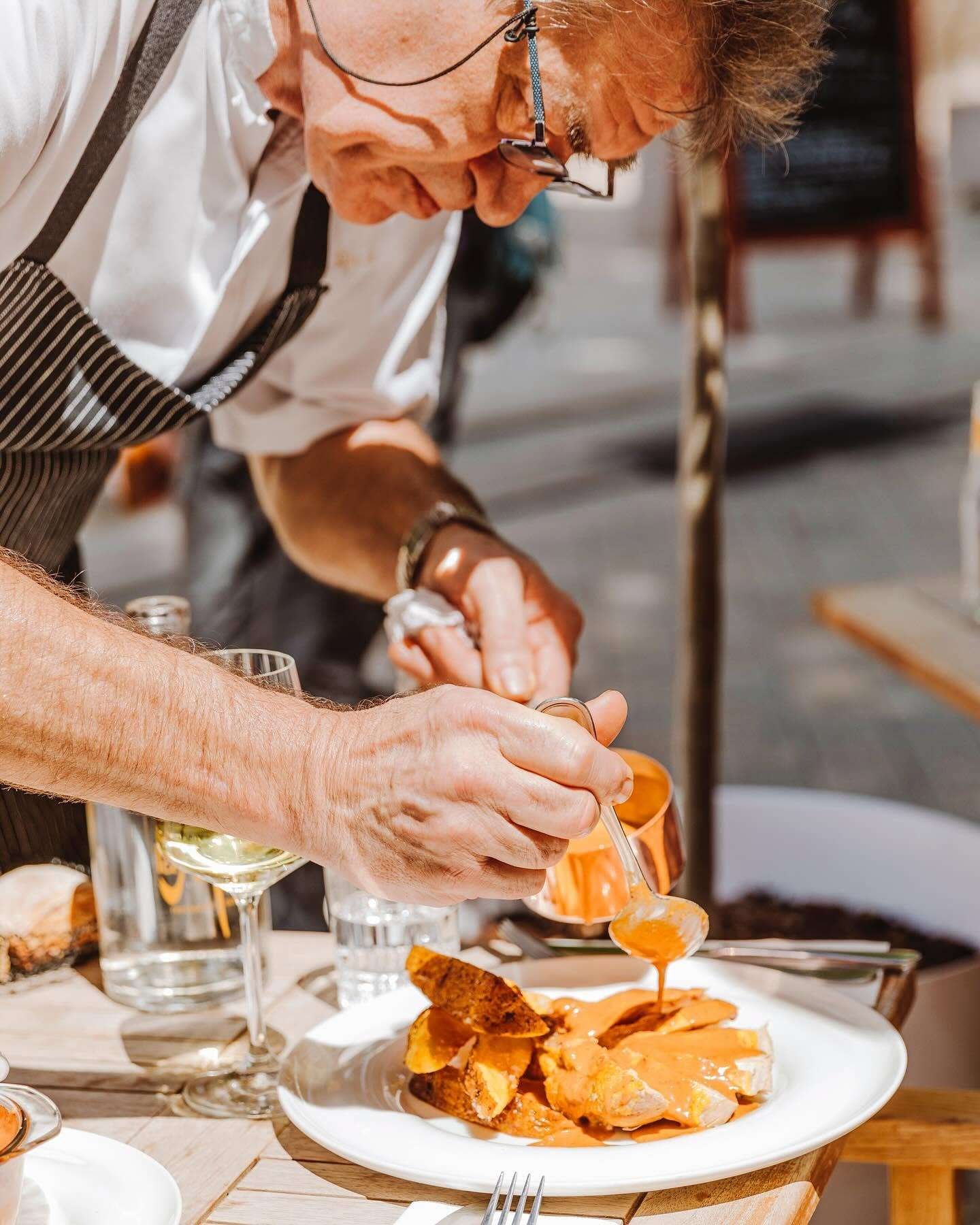
The square is best enjoyed from a terrace. On market mornings it comes alive early; in the afternoon it slows down, perfect for a break in the shade; in the evening the façades glow and the square becomes a meeting place.